Designing AI for Classroom Adoption
A qualitative study, in collaboration with KTH, into what actually drives adoption of AI-supported educational tools in Swedish classrooms. Understanding what makes educational AI work in real classrooms is fundamental for safe and positive implementation.
Authors: Yihan Zhu (LinkedIn) and Anton Falck (LinkedIn) Report date: 2026-10-16 Full report: KTH DiVA (urn.kb.se)
Introduction
AI-supported educational tools promise personalized learning, increased autonomy, and reduced teacher workload. Yet in real classrooms, adoption often stalls. We set out to understand why.
Together with KTH Royal Institute of Technology, we studied Swedish Grade 7 mathematics classrooms using a Design Thinking approach. From over 1,000 insights we distilled 20 customer values that explain what actually drives - or blocks - adoption.
The clearest finding: the barrier is rarely the AI's answer quality. It is the classroom ecology.
Tools must support real understanding without exposing students socially, protect teacher authority, reduce cognitive load, and fit naturally into existing workflows. In other words, educational AI works when it is designed as a classroom social tool first and a tutoring engine second.
Research Method
This study used Design Thinking as the overarching methodological framework, focusing on deeper qualitative insights in order to discover the human behavioural factors behind the mystery.
The study was conducted in Swedish schools and focused on students and teachers in mathematics education. Participants mainly came from Swedish Grade 7.
Data was collected through:
- 7 classroom observations
- 1 focus group
- 4 interviews with teachers
- 3 interviews with students
- 1 survey involving 101 students
Together, these activities generated over 1,000 individual insights.
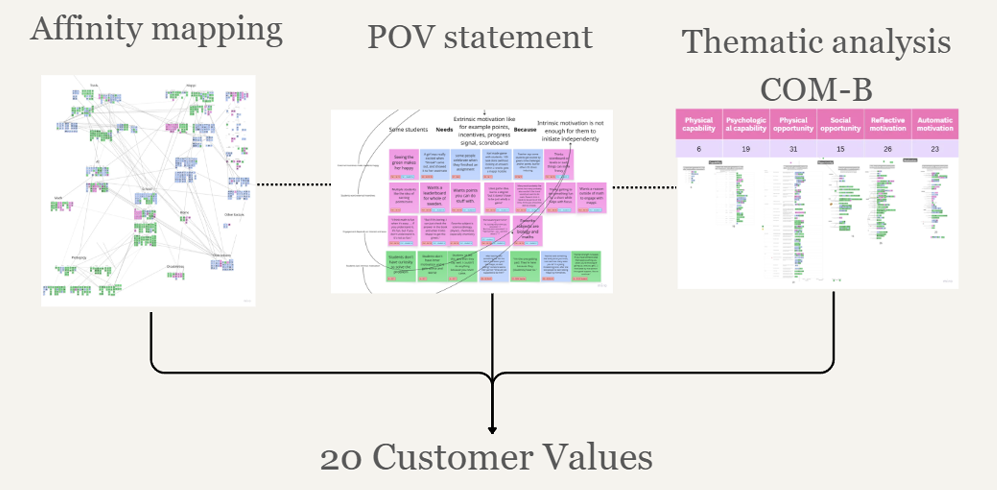
To make sense of this large amount of qualitative data, the findings were synthesized through affinity mapping, POV statements, and thematic analysis using the COM-B behavioural framework (Capability, Opportunity, Motivation). All findings were then condensed into 20 customer values in order to have an easy way to get an overarching holistic view into what the main users value.
Affinity Mapping
Affinity mapping - clustering similar individual insights - was used to organize observations, quotes, and behaviours into recurring themes. This helped identify common experiences, challenges, and behaviours shared across students and teachers.
POV Statements
The themes from the affinity mapping were translated into Point-of-View (POV) statements following the structure:
X needs X because X.
A total of 21 POV statements were generated, including 11 student POVs and 10 teacher POVs. The purpose of these statements was to transform observations into actionable needs that could guide further investigation and later design decisions.
Thematic analysis based on COM-B
The collected data was then analysed using thematic analysis based on the COM-B framework, which examines behaviour through Capability, Opportunity, and Motivation. This resulted in 120 themes with varying amounts of support:
| Dimension | Themes |
|---|---|
| Physical capability | 6 |
| Psychological capability | 19 |
| Physical opportunity | 31 |
| Social opportunity | 15 |
| Reflective motivation | 26 |
| Automatic motivation | 23 |
From Analysis to Customer Values
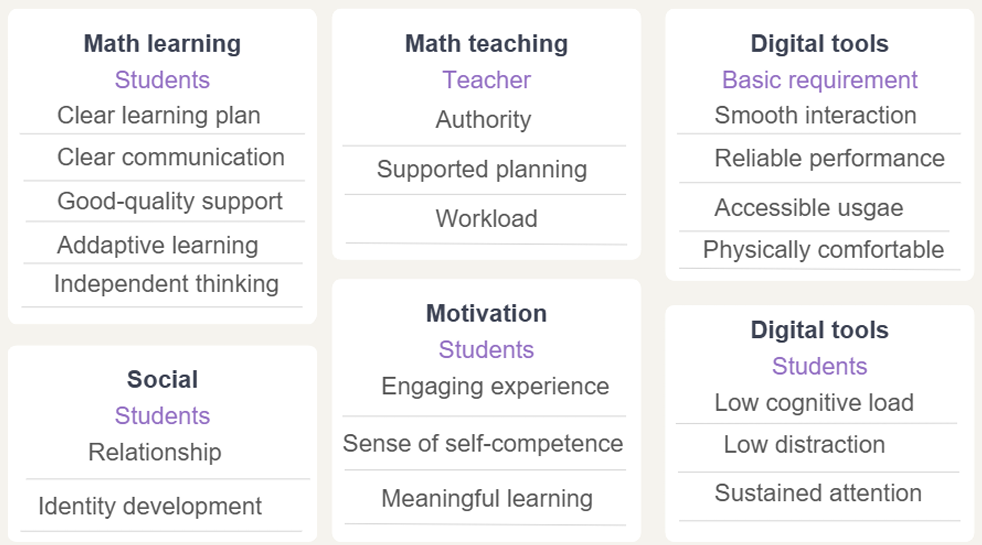
The resulting themes and POV statements were condensed into 20 customer values representing factors that influence the adoption of AI-supported educational tools. Rather than describing isolated product requirements, these values capture broader needs related to learning, motivation, social interaction, teaching practices, and digital tool usage.
20 Customer Values
First, the values under math learning and teaching. These values are important regardless of AI.
Then, when it comes to digital tools, design should first satisfy basic requirements to create positive initial experiences and first impressions. Second, because these are digital tools, distraction, attention and cognitive load need to be considered more carefully compared to traditional pen-and-paper learning.
Third, when considering long-term usage, motivation becomes increasingly important. This includes both internal and external motivational factors, which serve as reasons for users to continue using the tool over time.
Finally, social aspects. Although they may not directly improve adoption, educational tools should minimize negative impacts on social relationships, teacher-student interactions, and identity development, since those are important aspects of school life in general.
| Customer Value | How Educational AI Should Be Designed |
|---|---|
| Good-quality support | Provide support that is accurate, understandable, adaptive to different competence levels, and perceived as trustworthy enough to complement teacher support. |
| Adaptive learning | Allow students to learn at different paces and levels without exposing them to classmates or making them feel different. |
| Independent thinking | Guide students toward understanding and problem-solving rather than immediately providing answers that encourage dependency. |
| Clear communication | Present explanations, instructions, and feedback in ways that students can easily understand when learning independently. |
| Clear learning plans | Help students understand what they should learn, why they are learning it, and what to do next. |
| Smooth interaction | Reduce friction when navigating between content, exercises, AI support, and classroom activities. |
| Reliability | Ensure stable performance and minimize technical problems that interrupt learning or reduce trust. |
| Accessibility | Make support and learning resources easy to access whenever students become stuck. |
| Physical comfort | Minimize unnecessary switching between devices, windows, or tools that create frustration or fatigue. |
| Low cognitive load | Reduce the amount of information students must process simultaneously and avoid overwhelming interfaces. |
| Low distraction | Help students stay focused on learning tasks instead of unrelated content or competing digital activities. |
| Sustained attention | Support longer periods of concentration and engagement with mathematical problem-solving. |
| Engaging experience | Create enjoyable learning experiences that encourage students to return to the platform. |
| Sense of self-competence | Help students experience progress, success, and capability without feeling incapable when struggling. |
| Meaningful learning | Connect activities to genuine understanding and learning rather than only task completion or rewards. |
| Intrinsic motivation | Support curiosity, mastery, and personal growth rather than relying solely on points, badges, or gamification. |
| Relationships | Support interactions with teachers and classmates rather than replacing them with AI. |
| Identity | Protect students from negative social exposure and avoid making differences in ability publicly visible. |
| Authority | Keep teachers in control of AI functions, learning content, and classroom activities. |
| Planning and workload | Fit existing teaching workflows, reduce administrative effort, and provide useful support for planning and monitoring learning. |
From Research to Design
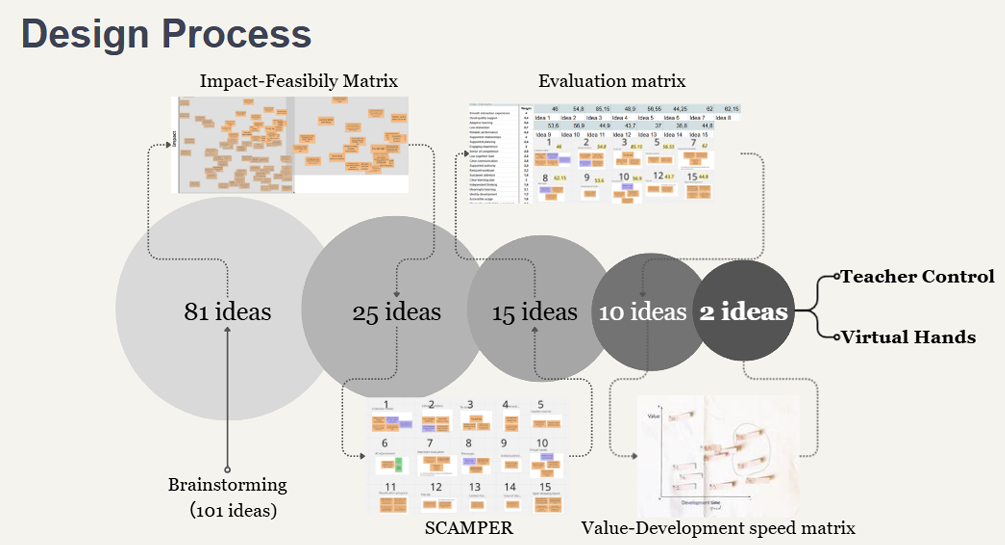
1st Round evaluation: Impact-Feasibility Matrix and SCAMPER
Perspective: Researchers Criteria: Impact and feasibility
A total of 101 ideas were generated from brainstorming using the 20 customer values, 81 of which were deemed worth looking into further. The ideas were positioned in an Impact-Feasibility Matrix, where impact represents the expected positive effect on adoption and feasibility represents how realistic an idea is assumed to be and how much effort is required to realize it.
The top-right quadrant was defined as Quick Wins, representing ideas with both high impact and high feasibility. A total of 25 ideas were selected for further development.
These ideas then went through SCAMPER, primarily using Combine and Eliminate, to merge overlapping ideas and remove redundancies. This process reduced the 25 ideas to 15 concepts for the next round of evaluation.
2nd Round evaluation: Weighted evaluation matrix
Perspective: Students and Teachers Criteria: 20 Customer Values
The 15 concepts were evaluated against the 20 customer values identified through the user research.
Each customer value was assigned a weight based on its importance in the research findings. Concepts were then scored according to how strongly they supported each customer value. The final score was calculated by multiplying the value weight by the concept score and summing the results across all customer values.
3rd Round evaluation: Value - Development speed
Perspective: Mappi Criteria: Value and Development Speed
The 10 most promising concepts, based on the previous evaluations, were then discussed together with the Mappi team using a Value-Development Speed Matrix in a co-evaluation workshop. After discussing what value the concepts would bring to the company and how fast they are realizable, 2 concepts were chosen to implement into Mappi.
Final Concepts
Based on the concepts that were chosen - the Teacher Control concept and the Virtual Hands concept - new features were added to Mappi.
Teacher Control
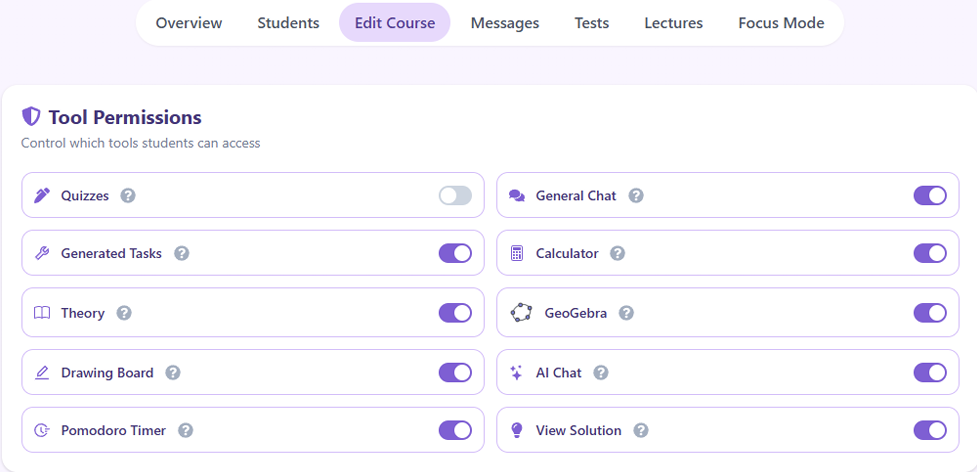
The Teacher Control feature was added to the course settings page as a Tool Permissions area, allowing teachers to add or remove student access to specific tools for individual courses. This functionality gives teachers greater control over how Mappi is used in their classrooms, supporting their authority and enabling them to introduce features gradually, reducing cognitive load when students are learning a new system, and limiting distractions caused by unnecessary tools. Unrelated to the 20 customer values, it also makes Mappi more accessible to teachers who may be hesitant to adopt AI-based features, as they can choose to disable the AI-based tools.
Virtual Hands
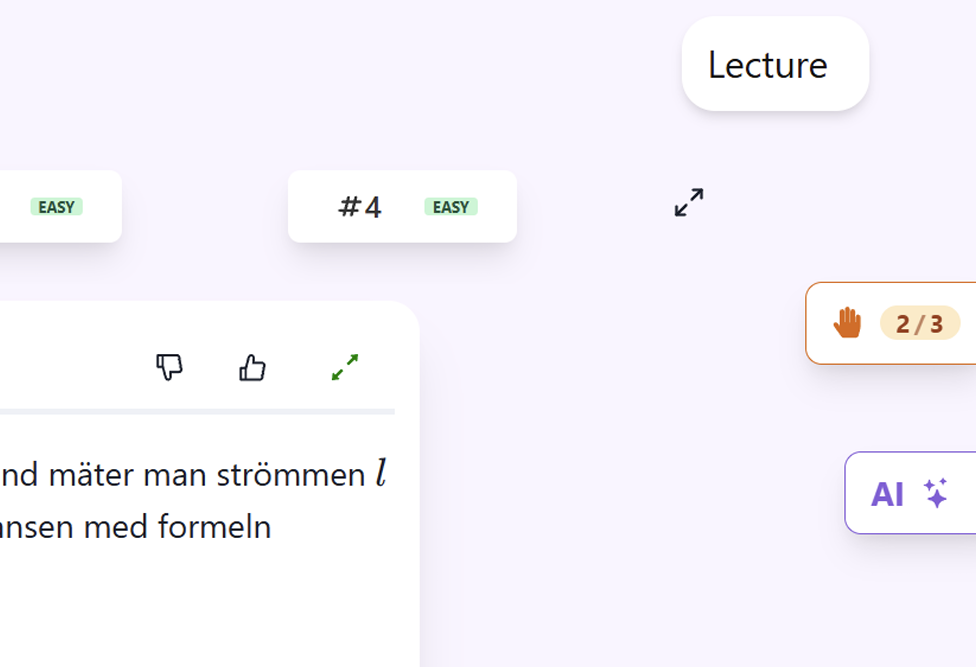
The Virtual Hands feature was integrated into the lesson pages. For students it was integrated as a new button to the side of the screen, allowing students to raise a virtual hand, see how many others are waiting, and view their position in the help queue.
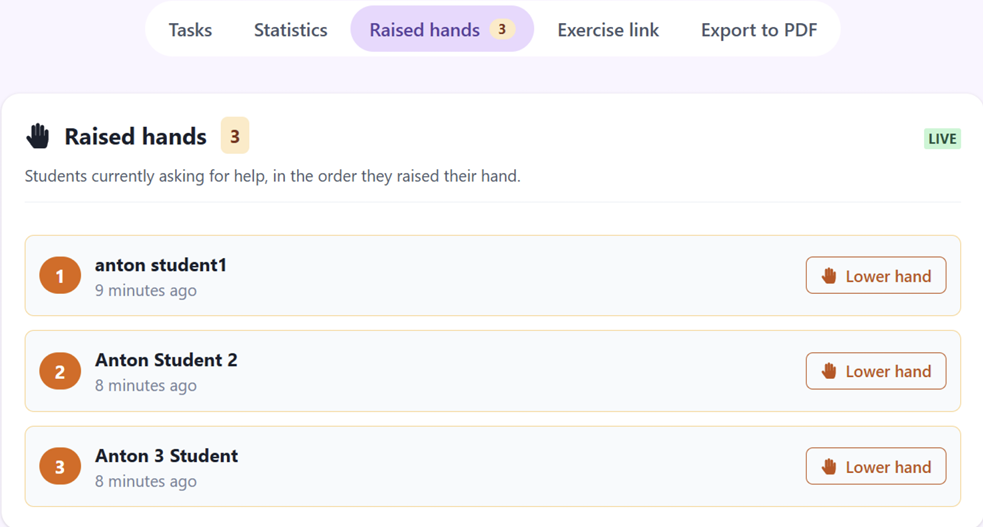
For teachers, a dedicated tab now shows which students need assistance and how long they have been waiting, allowing them to prioritize support more effectively. Teachers can also lower a student's hand themselves, in case a student forgets to do it after getting helped.
These features reinforce teacher authority, support stronger teacher-student interactions, and reduce cognitive load for both groups. Students can protect their identity since they can request help without drawing attention to themselves, while teachers gain a clearer overview of which students need help and can manage classroom support more efficiently.
Conclusion
The purpose of this project was to discover factors that affect the adoption of AI-based educational tools by doing primarily qualitative user research, in order to support developers in designing more effective AI-based educational tools. The research resulted in several POV statements, a thematic analysis and more, whose generated insights were summarized into 20 customer values. These were then used to develop design concepts for Mappi. Two of the concepts were deemed by Mappi to improve the platform and be realizable in the short term, and were implemented into Mappi.
The researchers feel that the stated purpose has been achieved to a satisfactory degree. Several overarching motivational, contextual and physical factors were discovered that seem to affect students' and teachers' ability and willingness to use educational tools, and those factors were used to generate design concepts that the developers of one such tool deemed would make their tool better.
The purpose has on the other hand not been perfectly achieved due to the fact that the research focused on specific ages of students, making it questionable whether the same factors apply to all levels of education. The research also focused on a math learning tool and students/teachers learning/teaching math, and thus might not be as applicable to educational tools focused on other subjects. The research additionally only focused on students and teachers, and thus some factors might have been overlooked, such as financial considerations from school administration.
For companies looking to use the findings from this project, the researchers recommend that the 20 customer values are used for initial concept generation in order to get more holistic idea generation and evaluation, and that companies targeting age groups outside the ones targeted in this project use the 20 customer values with care, as some factors might not be applicable in different age groups.